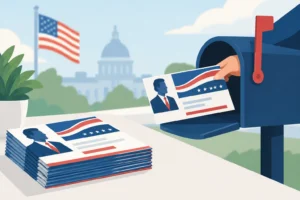
A voter who supports your candidate is not automatically a voter who shows up. Election Day conflicts, incomplete information, confusing voting rules, and simple inattention can keep reliable supporters at home. Get out the vote mailers give campaigns a direct, physical way to move identified supporters from intention to action – with the details and urgency they need to cast a ballot.
For candidates, PACs, ballot-measure committees, and political consultants, the objective is not broad awareness. It is turnout among the people most likely to be on your side. That requires more than a generic postcard dropped in the mail a few days before Election Day. It requires accurate voter data, a message tied to the voter’s situation, production discipline, and a mailing schedule built around actual postal delivery.
What Get Out the Vote Mailers Need to Accomplish
GOTV mail works best when it removes the friction between support and voting. A strong piece answers the practical questions quickly: when to vote, where or how to vote, what deadlines apply, and why this election merits the voter’s time. It should also reinforce the issue, candidate, or local outcome that originally earned that voter’s support.
The creative must be decisive. This is not the phase for a long policy platform or a biography-heavy persuasion piece. Your audience has already been modeled, identified, or contacted as a likely supporter. The job is to give them a reason to act now and a clear path to do it.
For an early-vote or vote-by-mail audience, that path may be a deadline, a ballot-return reminder, or instructions for confirming local procedures. For Election Day voters, it may be a simple, high-visibility reminder with polling information and a strong turnout message. Requirements vary by state and locality, so campaigns should verify election guidance and have counsel review all required notices and disclaimers.
Start With Voter Segments, Not a Postal Route
A mail piece can be beautifully designed and still miss its purpose if it reaches the wrong households. The highest-value GOTV universe is rarely every registered voter in a district. It is the group whose turnout can change the result: known supporters, modeled supporters, low-propensity supporters, favorable independents, previous donors, volunteers, or voters engaged on a specific issue.
Segmentation lets a campaign use its budget where it has leverage. A consistent voter with a strong partisan history may only need a brief reminder. A supporter who votes inconsistently may need a more personal message, an earlier drop, and repeated contact across mail and digital channels. Newly registered voters, voters who recently moved, and households with vote-by-mail histories can each require different instructions and timing.
Data quality is central to this work. Lists should be processed for duplicates, address standardization, deliverability, and suppression rules before files enter production. When data is outdated, mail can land after a deadline, reach a former resident, or waste budget on an ineligible record. A campaign should know exactly which audience received each version, when it entered the mail stream, and what response activity followed.
Use variable data to make the message relevant
Variable-data printing allows campaigns to tailor a mailer without slowing the entire production run. A voter can receive district-specific language, localized voting details, or a message aligned to their past engagement. The personalization should serve the action, not feel decorative.
For example, a ballot-measure campaign can vary a headline by community concern while holding its core turnout instruction constant. A candidate campaign can direct voters to the appropriate early-voting option based on their county or municipality. That level of relevance makes the mailer more useful and makes every postal impression work harder.
Build the Mail Schedule Backward From the Vote
Timing decides whether a GOTV mailer is helpful or irrelevant. The correct drop date depends on the election calendar, the voting method, the audience’s location, postal conditions, the number of touches planned, and the date by which voters must act.
Campaigns should work backward from key dates: registration cutoffs, vote-by-mail request deadlines, early-voting windows, ballot-return deadlines, and Election Day. Build in time for data processing, creative approval, printing, postal preparation, and USPS induction. Last-minute vendor handoffs create avoidable risk, especially when a voter universe changes or an election office updates instructions.
A multi-touch cadence often outperforms a single late mailing. An initial piece can establish the voting plan, a second can reinforce the deadline or early-voting window, and a final reminder can create urgency. But frequency is not automatically better. In a smaller district or with a limited budget, one highly targeted, well-timed piece may outperform a broad sequence that reaches less relevant voters.
The production partner should manage these details as an operating plan, not a print order. USPS-certified mailing, in-house lettershop operations, address hygiene, and trackable production milestones matter because Election Day does not move to accommodate a delayed campaign.
Design for Fast Decisions
A voter should understand the mailer in seconds. Put the action first, use a headline that makes the timing clear, and give the voting details enough visual weight to be found immediately. The candidate photo, issue message, or endorsement can reinforce motivation, but it should not bury the call to vote.
Use clean hierarchy, readable type, and a format that fits the message. Postcards can create fast visibility and work well for direct reminders. Self-mailers provide more room for voting instructions, endorsements, and local context. Letters can add credibility and personal tone for donors, volunteers, or highly engaged supporters. There is no universal winner; the best format depends on the audience, message complexity, and budget.
Compliance details deserve the same attention as the front-panel headline. Campaigns need accurate disclaimers, proper indicia or postage treatment, and verified election information. A knowledgeable partner can prepare the mail correctly, but the campaign remains responsible for legal and election-specific claims. Review language early, not after a full run is sitting on the production floor.
Reinforce Mail With Digital Response Channels
Mail is strongest when it is not asked to carry the full turnout program alone. A household that receives a voting reminder can also see coordinated messaging through email, social retargeting, paid media, text outreach where permitted, field contact, or volunteer calls. Repetition across channels improves recall while giving campaigns more chances to reach voters who do not act on the first touch.
The key is coordination. Digital ads should not contradict the deadline on the mailer. Call teams should use the same voting instructions. Field organizers should know which segments received which message. When every channel follows a common voter-contact plan, the campaign presents one clear instruction rather than a collection of disconnected tactics.
Managed Direct Response handles audience targeting, creative, variable-data printing, USPS mailing, fulfillment, and campaign reporting entirely through one accountable team. That structure reduces production gaps and gives campaign managers greater control over fast-moving GOTV timelines.
Measure What the Campaign Can Improve
Turnout mail is not measured like a retail offer with a simple purchase code. Still, campaigns can track meaningful signals: delivery timing, calls or web activity tied to campaign materials, digital engagement among mailed households, vote-plan commitments, and turnout performance across targeted segments after the election.
Use unique phone numbers, trackable URLs, QR codes when appropriate, and audience-level reporting to understand which messages and segments generated action. Be realistic about attribution. A voter may see a mailer, receive a call, and vote after an early-vote reminder from a friend. The goal is not to assign every ballot to one channel. It is to identify which outreach combination produced stronger turnout and make the next drop smarter.
The most valuable post-election review compares the original plan with actual execution. Did mail land when intended? Which segments were reached? Did the message match the voting calendar? Which universe showed the greatest turnout lift or engagement? Those answers turn a one-time mail program into a repeatable election operation.
The best time to solve a GOTV mailing problem is before the final week of the election. Build the audience early, verify the voting facts, approve the creative, and reserve enough production time to put a clear reminder in the right voter’s hands on time, every time.